
Stem Cell Therapy for Sports Rehabilitation
Stem Cell Therapy for Sports Rehabilitation
Stem cell therapy is an innovative rehabilitation method that accelerates tissue repair, reduces inflammation, and helps athletes return to peak performance faster and more safely.
Every day off the field, off the court, off the track is a day of deconditioning, lost momentum, and — for professional athletes — lost income and career capital. The competitive window is short. Careers are measured in seasons, not decades. And the traditional response to most serious sports injuries — rest, physical therapy, corticosteroid injections, time — has always moved at a pace that biology dictates, not ambition.
Regenerative medicine is beginning to change that calculus. Not by bypassing the healing process, but by accelerating and enhancing it at the cellular level — turning a twelve-month ACL recovery into eight, a career-threatening tendon tear into a setback rather than a full stop.
For athletes at every level, from weekend warriors to professional competitors, stem cell therapy is no longer a fringe option. It is an evidence-backed component of an emerging sports medicine paradigm built around one question: why wait for the body to heal slowly when you can give it the tools to heal better?
The Biology of Sports Injury
To understand why stem cell therapy works, you have to start with why sports injuries heal so poorly on their own.
The tissues most commonly injured in sport — tendons, ligaments, cartilage, and muscle — share a critical weakness: limited blood supply and, in many cases, a sparse population of resident repair cells. When a tendon tears or a ligament ruptures, the body initiates an inflammatory healing response that eventually deposits scar tissue — collagen type I — in place of the original structure. Scar tissue is not the same as the original tissue. It is less elastic, less mechanically strong, and less capable of withstanding the loads of athletic activity. This is why reinjury rates for repaired tendons and ligaments are significant, and why so many athletes who "recover" from major injuries are never quite the same.
Cartilage is even more limited. Articular cartilage has almost no vascular supply — healing nutrients and repair cells cannot reach it easily. When it is damaged — through acute trauma or the repetitive microtrauma of high-load sport — the body's capacity to restore it is minimal. The result, left untreated, is the progressive joint degeneration that ends careers and diminishes quality of life long after retirement.
Stem cell therapy targets this repair deficit directly. Rather than allowing the body to produce inferior scar tissue, it introduces — or activates — the biological machinery needed to regenerate tissue that is structurally closer to what was lost.
How Stem Cells Work in Sports Injuries
The key cell type in sports medicine regeneration is the mesenchymal stem cell (MSC) — a multipotent progenitor cell found in bone marrow, adipose tissue, synovium, and umbilical cord tissue. MSCs address the biology of sports injury through four overlapping mechanisms:
Tissue regeneration
MSCs are multipotent — they can differentiate into the cell types that make up damaged structures. In the context of sports injuries: - Into tenocytes (tendon cells) — promoting regeneration of tendon matrix with superior structural organization compared to scar tissue - Into chondrocytes (cartilage cells) — rebuilding the articular cartilage that acute injury or repetitive loading has damaged - Into myoblasts (muscle precursor cells) — supporting the repair and regeneration of damaged muscle tissue - Into osteoblasts (bone cells) — enhancing bone healing in stress fractures and avulsion injuries
Anti-inflammatory action
The acute inflammatory response to injury is necessary for initiating repair — but chronic or excessive inflammation impairs it. MSCs modulate the inflammatory microenvironment, reducing pro-inflammatory cytokines (IL-1β, TNF-α) while promoting the transition from the inflammatory phase to the proliferative, repair-oriented phase of healing. For athletes, this means getting through the early painful phase faster and arriving at productive tissue remodeling sooner.
Paracrine signaling
Even when MSCs don't differentiate into new tissue cells, they do something equally powerful: they release growth factors and signaling molecules — TGF-β, PDGF, VEGF, IGF-1, HGF — that activate the tissue's own resident repair cells, stimulate collagen synthesis, promote angiogenesis (new blood vessel formation), and suppress the apoptosis (cell death) that impairs healing in the injured area. The result is a broader, more organized regenerative response than the body can produce alone.
Scar tissue reduction
By modulating the inflammatory response and stimulating organized collagen deposition, MSC therapy reduces fibrosis — the formation of disorganized scar tissue — and promotes the deposition of type II collagen (structurally superior for cartilage) and organized type I collagen (mechanically stronger for tendons and ligaments). This is the difference between healing back and healing better.
Applications by Injury Type
Tendon Injuries — Rotator Cuff, Achilles, Patellar, Hamstring
Tendon injuries are among the most common and most career-disrupting in sport. Partial tears, tendinopathy from overuse, and complete ruptures that require surgical repair all share a common outcome limitation: tendon-to-bone healing is slow, structurally imperfect, and carries a significant retear rate.
A 2025 meta-analysis published in ScienceDirect evaluated five clinical studies of arthroscopic rotator cuff repair with and without MSC augmentation. The analysis found that MSC augmentation produced a higher structural integrity rate — meaning the repaired tendon was more likely to heal completely and durably — compared to isolated surgical repair alone. The functional outcomes were at least equivalent, with the structural advantage of MSC augmentation being the key differentiator: a repair that holds is a recovery that lasts.
A randomized, placebo-controlled clinical trial published in Scientific Reports investigated intra-tendon MSC injection for rotator cuff tears specifically — an important methodological step, since controlled trials are rare in this area. The trial documented structural and clinical improvements at 6, 12, 24, and 104 weeks post-injection, providing one of the few long-term datasets for tendon MSC therapy in a rigorous trial design.
For Achilles tendon pathology, hamstring tears, and patellar tendinopathy — injuries that define the careers of sprinters, footballers, and jumping athletes — MSC therapy is increasingly used either as a primary treatment for partial tears or as augmentation alongside surgical repair, with the goal of improving the quality and durability of the healed tissue.
Articular Cartilage Damage — Knee, Ankle, Hip
Cartilage damage from acute sports trauma — osteochondral defects, chondral lesions from impact — or chronic microtrauma presents one of the most clinically challenging problems in sports medicine. Left unaddressed, it accelerates the joint degeneration that ends athletic careers years ahead of time.
MSC therapy for cartilage repair in athletes targets the restoration of hyaline cartilage — the structurally superior tissue that lines joint surfaces — rather than the fibrocartilage scar tissue that conventional healing produces. Multiple clinical studies have demonstrated cartilage repair on MRI following MSC injection, with corresponding improvements in pain and function. For athletes with early to moderate cartilage damage, MSC therapy can interrupt the progression toward osteoarthritis and maintain the joint health needed for continued high-level performance.
Ligament Injuries — ACL, MCL, PCL, Ankle Ligaments
Ligament reconstruction — particularly ACL reconstruction — is one of the most common major surgeries in sports medicine. The standard graft (hamstring or patellar tendon autograft) requires extensive rehabilitation and carries a retear risk, particularly in return-to-sport scenarios.
MSC therapy is being investigated as both an augmentation to standard ACL reconstruction — improving graft-to-bone integration and ligament maturation — and as a primary treatment for partial ligament tears that fall short of the threshold for surgery. In a double-blind RCT, allogeneic MSCs combined with hyaluronic acid administered after ACL reconstruction preserved joint space and reduced cartilage volume degradation on MRI — a protective effect on the joint itself, not just the graft.
Muscle Injuries — Tears, Contusions, Chronic Strains
Muscle injuries — from grade II hamstring tears to quad contusions — typically heal through fibrosis when significant, producing scar tissue that reduces contractile strength and creates a focal weakness predisposing to reinjury. MSC-mediated muscle regeneration, by promoting myoblast activity and organized extracellular matrix deposition, reduces the fibrotic component and improves the structural quality of repaired muscle. For athletes managing recurrent muscle injuries at the same site, MSC therapy addresses the underlying tissue quality issue that makes reinjury likely.
Stress Fractures and Bone Healing
MSCs' osteogenic differentiation capacity makes them valuable in accelerating bone healing in stress fractures — a particular concern in endurance athletes and military personnel — as well as in avulsion injuries and delayed unions. MSC-augmented bone healing has been studied in orthopedic settings for decades, and the evidence base is among the most established in the regenerative medicine field.
The Evidence: What Clinical Studies Show
The evidence base for MSC therapy in sports injuries is growing rapidly, though it remains more heterogeneous than in established medical applications like joint OA. What the available clinical data consistently shows:
In rotator cuff repair, MSC augmentation significantly improves tendon structural integrity rates compared to surgical repair alone — with a higher proportion of patients showing complete healing on MRI and lower retear rates at 12 and 24 months.
In cartilage repair, MSC therapy produces structural changes visible on MRI — increased cartilage volume, improved T2 signal characteristics indicating better tissue organization — alongside consistent clinical improvements in pain and function.
In tendinopathy, multiple case series and early controlled trials report significant reductions in pain scores, improvements in functional assessments, and sonographic evidence of tendon structural improvement at 3 and 6 months following MSC injection.
The common thread across these applications is not simply symptom relief — it is structural tissue improvement, confirmed on imaging. The goal of sports medicine is not just to reduce pain but to restore the tissue integrity that allows an athlete to return to full training and competition. Imaging-confirmed structural repair is the evidence that this is occurring.
The Athlete's Experience: What to Expect
Step 1 — Assessment A thorough evaluation including clinical examination, MRI of the affected structure, and discussion of injury history, rehabilitation progress to date, and performance goals. The goal is not just confirming the injury but understanding what tissue quality is present and what regenerative potential exists.
Step 2 — Cell Source Selection For acute injuries in generally healthy athletes, autologous cells — harvested from the patient's own bone marrow (via a brief aspiration from the iliac crest) or adipose tissue (via minimally invasive lipoaspiration under local anesthetic) — offer the advantage of using the body's own biological material. For athletes requiring rapid turnaround without a harvest procedure, allogeneic umbilical cord-derived MSCs provide an off-the-shelf option with a strong safety profile.
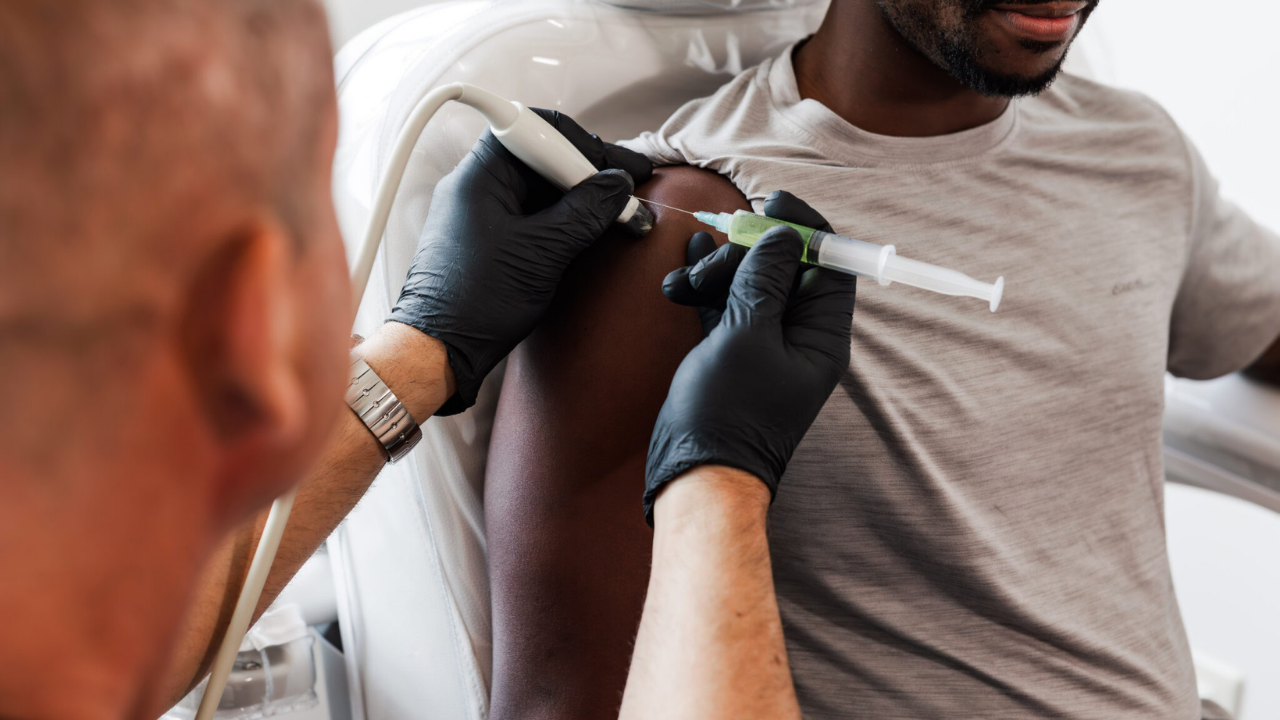
Step 3 — Injection Cells are delivered under ultrasound or fluoroscopic guidance directly to the injured structure — intra-tendinous, intra-articular, or perilesional depending on the target tissue. Precision of delivery is critical: the cells need to be in the tissue they are repairing. The procedure itself takes approximately thirty to sixty minutes.
Step 4 — Structured Rehabilitation Integration This is not a treatment that works in isolation. MSC therapy creates the biological conditions for better tissue healing; rehabilitation provides the mechanical stimulation that directs that healing into a properly organized, load-bearing structure. Progressive loading protocols — calibrated to the stage of tissue repair — are essential for maximizing outcomes. Athletes working with sports medicine physiotherapists who understand regenerative augmentation will see significantly better results.
Step 5 — Return-to-Sport Timeline Response varies by injury severity and tissue type. Tendon and cartilage injuries typically show meaningful improvement at 6–12 weeks, with continued maturation through 6–9 months. Return-to-sport decisions should be based on objective tissue quality assessment (MRI, functional testing) rather than time alone — which is equally true whether or not MSC therapy is used.
Important Considerations for Competitive Athletes
Anti-doping regulations: MSC therapy is not currently prohibited by the World Anti-Doping Agency (WADA). However, competitive athletes should confirm the status of any specific cell product with their national anti-doping authority before treatment, as regulations can evolve.
Timing relative to competition: Optimal timing of MSC therapy should consider competition schedules. Early post-injury treatment takes advantage of the inflammatory environment, which supports cell engraftment, but activity restriction in the days following injection must be factored into planning.
Managing expectations around timeline: MSC therapy accelerates and improves healing — it does not eliminate the biological time requirements of tissue repair. Athletes should be cautious of programs that promise unrealistically rapid return-to-sport timelines. The goal is a better recovery, not a faster one at the expense of tissue quality.
Frequently Asked Questions
Is stem cell therapy safe for young athletes? The safety profile of MSC therapy in orthopedic applications is well established across multiple clinical trials, with no serious adverse events attributable to the cell therapy itself. For adolescent athletes, age-appropriate protocols exist and individual assessment guides application.
Can this be done during the season? In many cases, yes — particularly for partial injuries that do not require surgical intervention. The procedure itself is minimally invasive, and some athletes return to modified training within days, with full return guided by tissue response. Season-specific planning is part of the consultation.
How does this compare to PRP? PRP (platelet-rich plasma) delivers growth factors from the patient's blood and can reduce inflammation and support healing — but it does not contain stem cells and cannot differentiate into new tissue. MSC therapy is biologically more comprehensive and is supported by stronger structural repair evidence. The two can be combined for enhanced effect.
What is the retear rate after MSC-augmented tendon repair? The 2025 meta-analysis of MSC-augmented rotator cuff repair documented a significantly higher structural integrity rate (lower retear rate) compared to repair alone. Specific numbers vary by study and tear severity, but the consistent direction of the evidence is that MSC augmentation improves the durability of tendon repair.
Can stem cell therapy help with chronic overuse injuries? Yes. Chronic tendinopathy — Achilles, patellar, medial epicondyle — is a well-studied indication for MSC therapy. Chronic overuse injuries produce degenerative tendon tissue with poor cellularity; MSC injection directly addresses this by repopulating the tendon with biologically active cells and promoting tissue remodeling.
Is this appropriate after previous surgery? Often yes. Post-surgical tissue with suboptimal healing, persistent tendinopathic change, or failed repair is a recognized indication for MSC therapy as a secondary intervention. Your specialist will review previous surgical records and imaging to assess whether regenerative augmentation is appropriate.
The New Standard in Sports Medicine
The best athletes in the world are increasingly demanding more than symptom management from their medical teams. They want to know that when injury strikes, the response will not just manage the damage — it will restore the tissue as close to its original state as possible, as durably as possible.
Stem cell therapy does not replace the work of rehabilitation. It does not replace surgical repair when repair is necessary. What it does is upgrade the biological quality of the healing that follows — giving athletes a structural foundation for recovery that conventional approaches alone cannot provide.
For athletes who measure their careers in seasons, and their performance in margins, that biological upgrade matters.
Schedule a consultation to find out whether regenerative therapy is appropriate for your injury and what an integrated recovery plan looks like for your specific situation.
This article is for informational purposes only and does not constitute medical advice. Sports injury management should always be conducted under the supervision of qualified sports medicine specialists.
Quick Question